
The Day We Realized We Weren't Modeling Aircraft

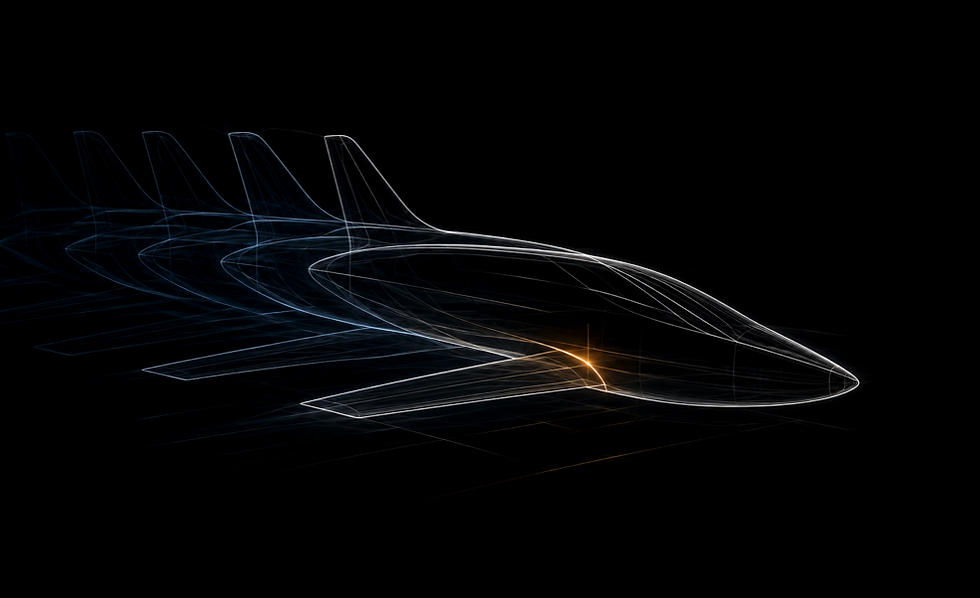
We thought we were building a 3D model of an aircraft.
We were wrong.
What we were actually building was a way to see change.
The original idea seemed simple enough. Capture an aircraft with a level of detail that would allow us to create a highly accurate digital representation of its exterior condition. Every panel, every rivet line, every antenna, every surface detail preserved in a way that could be viewed, measured, and revisited long after the aircraft had left the hangar.
At first, the model itself seemed to be the goal. The better the model, the greater the value. More detail. More accuracy. More information.
But the deeper we explored the concept, the more we realized that a single model only tells part of the story.
A model captures what existed on a specific day. It freezes a moment in time. While that has obvious value, aircraft ownership has never really been about a single day. Aircraft ownership is a long conversation between time, maintenance, environment, usage, and care. The aircraft sitting on the ramp today is not the same aircraft that sat there six months ago, even if it appears unchanged to the casual observer.
That realization led us to a different question.
Not, "What does the aircraft look like?"
But rather, "What is changing?"
The difference between those questions may seem subtle, but it fundamentally changes the purpose of the model.
Aircraft rarely announce their problems. Corrosion develops quietly. Paint degradation progresses gradually. Small surface anomalies emerge long before they become obvious concerns. Wear accumulates one flight, one season, and one maintenance cycle at a time. By the time many issues become visible, the process that created them has often been underway for months or even years.
Most of the systems surrounding aircraft ownership are designed to preserve history. Logbooks document inspections and repairs. Maintenance records document actions taken. Airworthiness directives document compliance. Service bulletins document recommendations and modifications. These records are essential, and they form the backbone of responsible aircraft ownership.
Yet the aircraft itself is maintaining a parallel record.
Its surfaces remember.
The paint remembers.
The fasteners remember.
The panel seams remember.
The subtle patterns of weathering, vibration, stress, and exposure all leave traces behind. The logbook records what happened. The aircraft records what happened to it. Those are not always the same story.
The more we thought about this, the more we realized that the model was never the destination. It was merely the baseline.
The true value emerged when one model was compared to another.
A single scan documents condition.
A sequence of scans documents change.
And change is where the story lives.
Suddenly the conversation shifts away from what the aircraft is and toward what it is becoming. Small differences that would otherwise go unnoticed begin to stand out. Areas that appear perfectly normal in isolation reveal patterns when viewed over time. The comparison becomes more valuable than any individual scan because it introduces something that a single snapshot never can: continuity.
That idea extends beyond aviation. In almost every complex system, significant failures begin as subtle changes. The challenge is rarely that the change is invisible. The challenge is that no baseline exists to reveal it. Without continuity, everything appears normal right up until the moment it doesn't.
That may have been the most important lesson we learned during this journey.
The aircraft was never the story.
The model was never the story.
Even the technology was never the story.
Change was the story.
Because aircraft ownership is not simply about understanding what an aircraft is today. It is about understanding what that aircraft is becoming tomorrow. And sometimes the difference between those two questions is where the most valuable insights are found.
THE FLYING LIZARD®
Aviation-Driven Drone Intelligence™
Where People and Data Take Flight™


Comments