
The TikTok Fix: When ‘It Looks Right’ Isn’t Enough

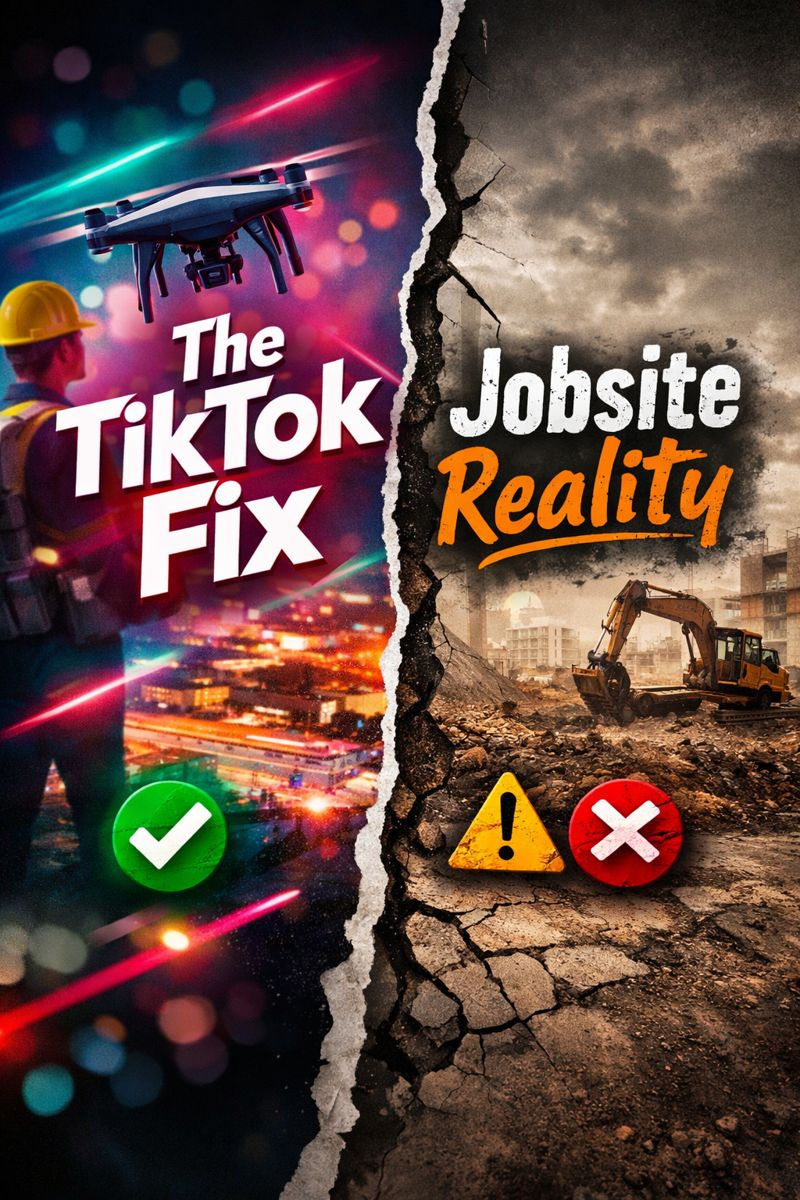
When “It Looks Right” Meets Speed, Pressure, and Consequences
There’s a certain comfort in watching a problem disappear on screen. A quick fix, a confident hand, a clean result—proof delivered in seconds. In the TikTok era, resolution is visual and immediate, and the absence of friction feels like success. But construction doesn’t live in the moment of the fix. It lives in what follows—when speed increases, pressure builds, and reality begins asking harder questions than the screen ever did.
Anyone with roadside experience will tell you what social media often leaves out. That plug isn’t a repair. It’s a pause. It buys time, but it also borrows risk. It’s meant to get you off the shoulder, not carry you indefinitely at highway speeds. The problem isn’t the tool itself—it’s the false confidence that comes when something appears fixed.
We live in an age that rewards claims. Quick solutions. Confident statements. “This replaces that.” “We already do this.” “It’s good enough.” Proof is visual now—immediate and persuasive. But claims don’t experience consequences. Reality does. Reality shows up later, when margins shrink, tolerances tighten, and decisions are locked in place.
Construction has its own version of the screw-in tire plug, and it often arrives by drone. The flight goes up. The map comes back. The ortho looks right. For a moment, everything feels handled. But once that data is trusted—fed into BIM, used for quantities, alignment, or elevation—the pressure begins to build. Just like the tire, the question becomes less about appearance and more about endurance.
Many firms will say, honestly, that they already have a drone program. And they’re not wrong. But flying a drone is not the same thing as knowing what the data can withstand. One produces imagery. The other supports decisions. One satisfies visibility. The other survives accountability. The most dangerous data in a project isn’t bad data—it’s data that looks trustworthy enough to rely on, right up until it isn’t.
Temporary fixes aren’t inherently bad. In fact, they’re often necessary. The roadside plug has its place, as long as everyone understands what it is and what it is not. Problems arise when temporary solutions quietly become permanent assumptions. In construction, that’s when small inaccuracies compound, confidence erodes, and rework appears—not loudly, but gradually, under the surface.
This is where THE FLYING LIZARD lives. Not in flying more missions or flooding projects with data, but in asking a harder question: What will still hold when this project is moving fast? Sometimes the answer is a targeted flight at the right moment. Sometimes it’s validation instead of coverage. And sometimes it’s restraint—choosing precision over volume.
A proper repair is rarely glamorous. Installed from the inside, it isn’t seen once the wheel goes back on. But it’s designed to endure heat, speed, and load without drama. In the end, social media rewards what looks solved. Construction rewards what actually holds. The difference between the two isn’t technology. It’s judgment. And judgment only reveals its value when pressure arrives.
TikTok is referenced here as a cultural shorthand for short-form, attention-driven media—not the platform itself.
THE FLYING LIZARD®
Aviation-Driven Drone Intelligence™
Where People and Data Take Flight™


Comments